BR-Shield
Bullet resistant systems
BR6 and FB6 bullet resistant systems in cold-rolled steel — a door system, a fixed partition system or a cap curtain wall facade, with glass in the system. Trialled at TBRL Chandigarh and NFSU Gandhinagar.
BR6FB6
No section drawing is published for this range. The best source available is a 1080 × 300 image carrying eight sections at about two pixels per millimetre — a 1.5 mm steel wall is three pixels — and wall thickness, screw ports and gasket seats are exactly what a consultant reads a section for. A DWG or a native-scale PDF is what this slot is waiting for.
846–860m/s
Velocity achieved at NFSU
820–840m/s
EN 1063 BR6 velocity band
6
Shots, no perforation
Steel systems made by Firetec. The frame is specified together with the glass it holds, rather than assembled from whatever is available.
Introduction
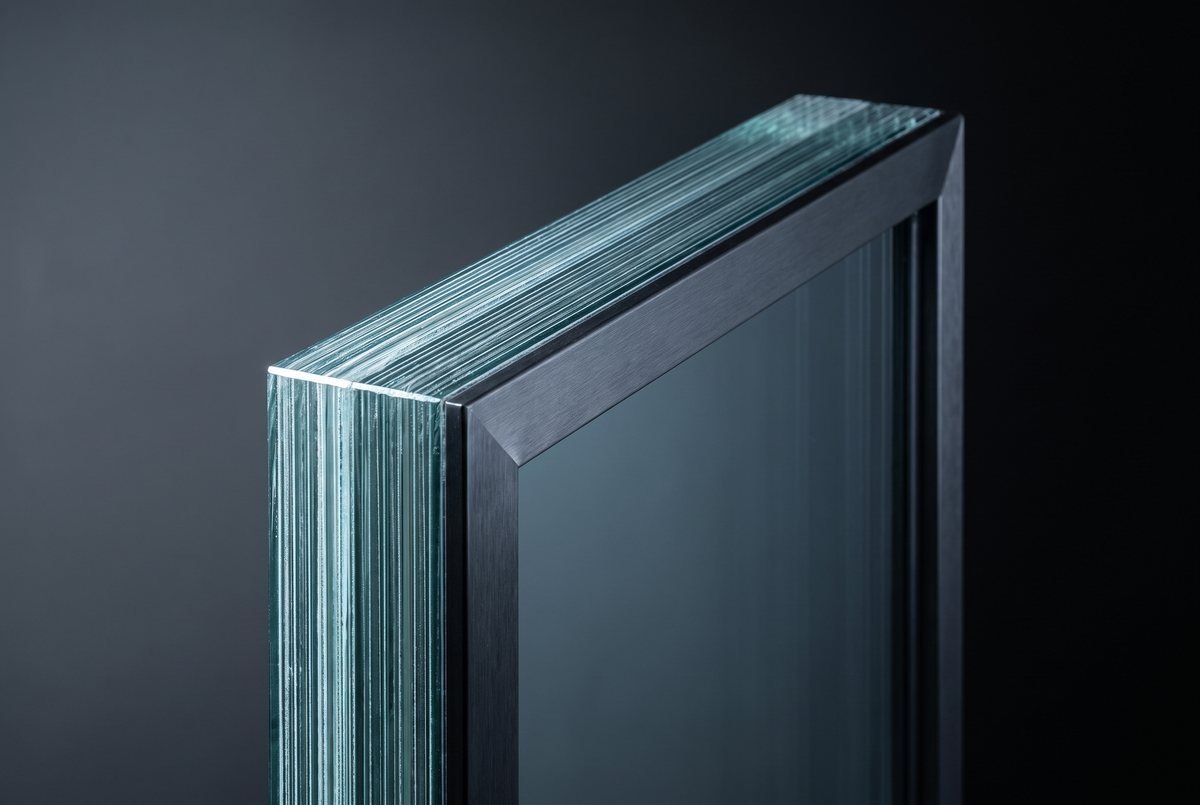
BR-Shield is a bullet resistant system: a cold-rolled steel frame with glass in it, rather than glass sold on its own. That is the whole point. A pane that stops a round and a frame that lets it out of the opening are the same failure, and the frame is where bullet resistant glazing is most often specified badly. Firetec makes the steel.
The range is built as three systems on one steel system — a door system, a fixed partition system, and a cap curtain wall facade — with splintering and non-splintering glass options. It is made in India, which for a product this heavy is a delivery argument as much as a cost one.
TBRL Chandigarh, a DRDO laboratory · NFSU Gandhinagar, Ballistic Research Centre, ISO 9001:2015
Both laboratories fired at BR-Shield and neither perforated it, at velocities of 846 to 860 m/s — above the EN 1063 BR6 band. Both reports record the standard as EN 1522 FB6 and EN 1063 BR6 with partial compliance, which is why this page says “tested to” and not “certified”. That is what the documents say.
The reports are restricted, so no scan, shot table or per-shot velocity list is shown. What is stated is the outcome.
EN 1063 · BR2–BR7
The threat levels, and where this system sits
Pick a level to see the round, the velocity band and the weapon class it is defined against. The thickness column is flagged throughout: EN 1063 specifies a threat and a velocity, not a glass thickness, and Firetec’s published figures for that column are not internally consistent.
Handgun
The commonest handgun round in the world. This is the level most retail and reception counters are specified at.
| Ammunition | 9 × 19 mm | EN 1063 |
|---|---|---|
| Projectile | Full metal jacket, soft core, 8.0 g | EN 1063 |
| Velocity band | 390–410 m/s | EN 1063 |
Revolver
A heavier handgun round at a similar velocity. Cash handling and teller lines are commonly specified here.
| Ammunition | .357 Magnum | EN 1063 |
|---|---|---|
| Projectile | Full metal jacket, cone, soft core, 10.2 g | EN 1063 |
| Velocity band | 420–440 m/s | EN 1063 |
Revolver
The heaviest handgun threat in the standard, and the top of the pistol range before rifle levels begin.
| Ammunition | .44 Remington Magnum | EN 1063 |
|---|---|---|
| Projectile | Full metal jacket, flat nose, soft core, 15.6 g | EN 1063 |
| Velocity band | 430–450 m/s | EN 1063 |
Assault rifle
The first rifle level. More than twice the velocity of BR4 on a fraction of the mass — a different failure mechanism, not a harder version of the same one.
| Ammunition | 5.56 × 45 mm | EN 1063 |
|---|---|---|
| Projectile | Full metal jacket, pointed, soft core with steel penetrator, 4.0 g | EN 1063 |
| Velocity band | 940–970 m/s | EN 1063 |
Battle rifle
The level BR-Shield has been trialled at, at two laboratories. This is where the section below picks up.
| Ammunition | 7.62 × 51 mm | EN 1063 |
|---|---|---|
| Projectile | Full metal jacket, pointed, soft core, 9.5 g | EN 1063 |
| Velocity band | 820–840 m/s | EN 1063 |
Battle rifle, hard core
Same round and same velocity band as BR6; what changes is a hardened steel core. The published thickness roughly doubles.
| Ammunition | 7.62 × 51 mm | EN 1063 |
|---|---|---|
| Projectile | Full metal jacket, pointed, hard steel core, 9.8 g | EN 1063 |
| Velocity band | 820–840 m/s | EN 1063 |
Where BR-Shield sits against BR6
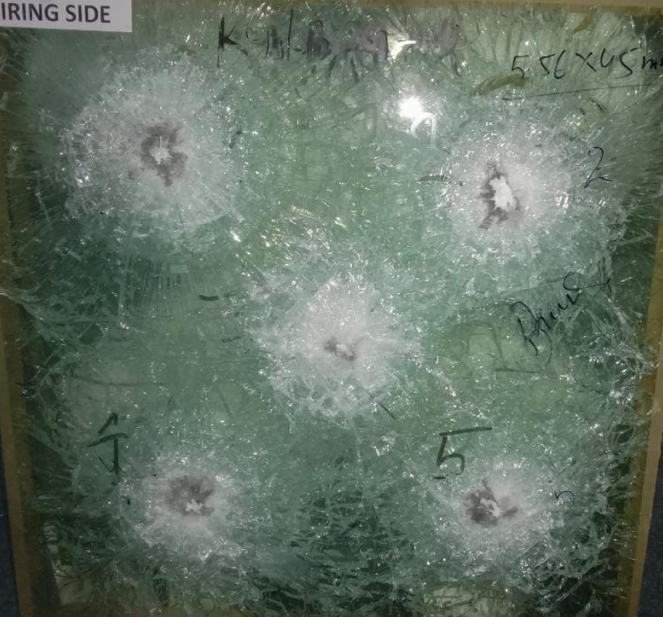
EN 1063 defines BR6 as 7.62 × 51 mm at 820 to 840 metres per second. At the NFSU Ballistic Research Centre, BR-Shield was shot at 846 to 860 metres per second — above the band the standard sets, on every one of six shots — and none of them perforated it. At TBRL Chandigarh, a DRDO laboratory, six more shots at the top of the band gave the same result.
That is a stronger statement than “certified”, and unlike “certified” it is one both reports actually support: each records the standard as partial compliance. Neither report is reproduced here in any form, which is why this section states an outcome and prints no figures from either document.
After the trial
What twelve rounds of 7.62 × 51 leave behind
Photography from the ballistic trials.
Specification
What the reports record
Every row names its source. Where the reports, the catalogue and the previous website disagree, this table prints every candidate value and flags the row rather than picking one.
| Tested to | EN 1063 BR6orEN 1522 FB6 | TBRL and NFSU |
|---|---|---|
| Velocity | 846–860 m/s | NFSU |
| Ammunition | 7.62 × 51 mm | TBRL and NFSU |
| Result | Six shots at each laboratory, no perforation | TBRL and NFSU |
| Material | Cold-rolled steel system, with laminated glass in the system | Firetec |
| Options | Splintering (S) and non-splintering (NS) | Firetec |
| Applications | Door system · fixed partition system · cap curtain wall facade system | Firetec |
| Laboratory | TBRL Chandigarh is a DRDO laboratory; NFSU BRCTR is ISO 9001:2015 | Reports |
Where it goes
Sectors this system is specified into
The argument you have to make to a consultant changes with the building type. These are the three this range comes up in most often.
846–860m/s
Fired at NFSU, BR6 band 820–840
Banking and finance
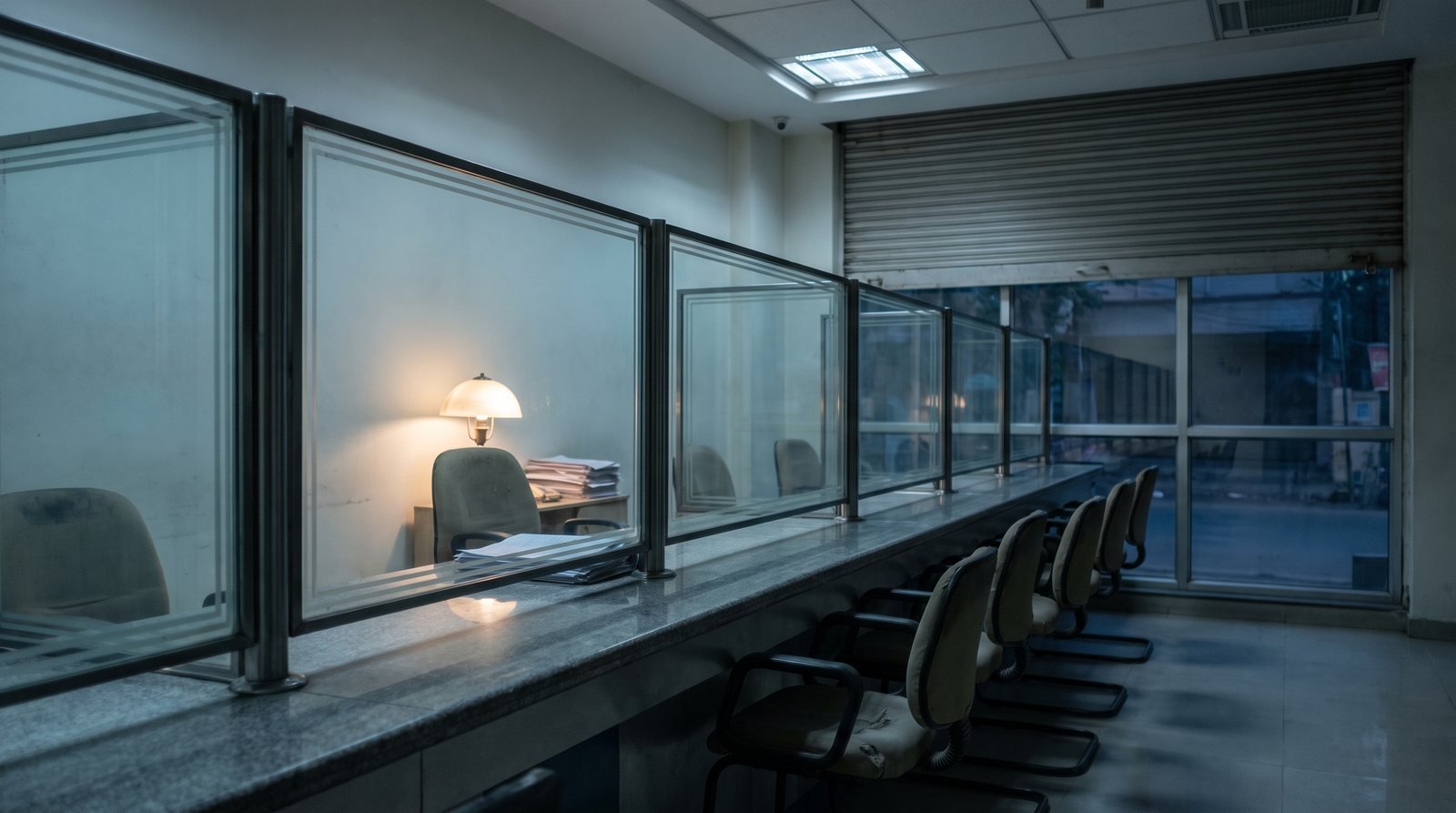
Teller lines and cash handling, where the fire case and the ballistic case are the same wall.
60–200mm
Profile depth, for span
Airports and transit
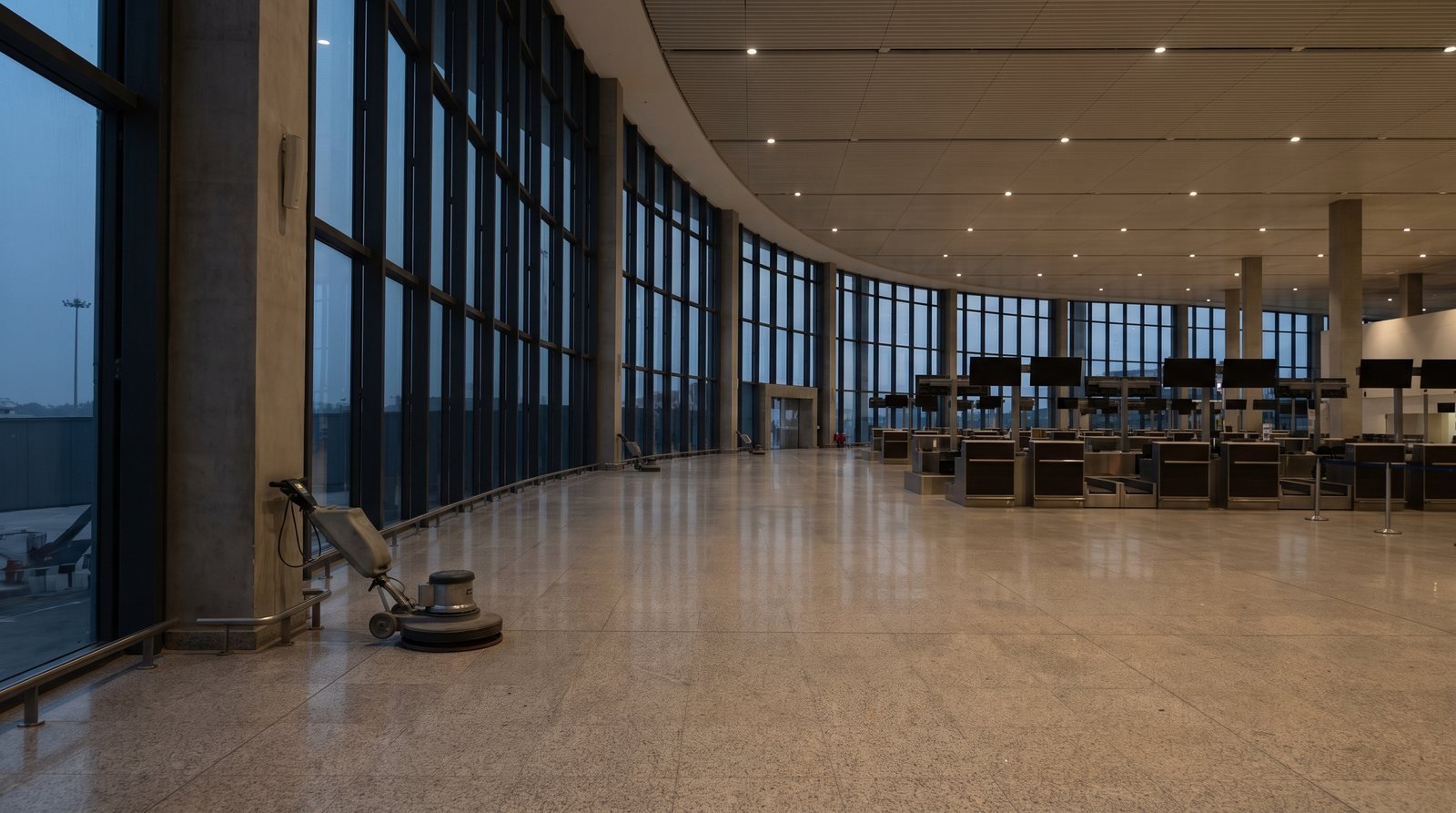
Long glazed spans, high footfall and security screening in the same envelope.
15kW/m²
The EW threshold, at one metre
Data centres
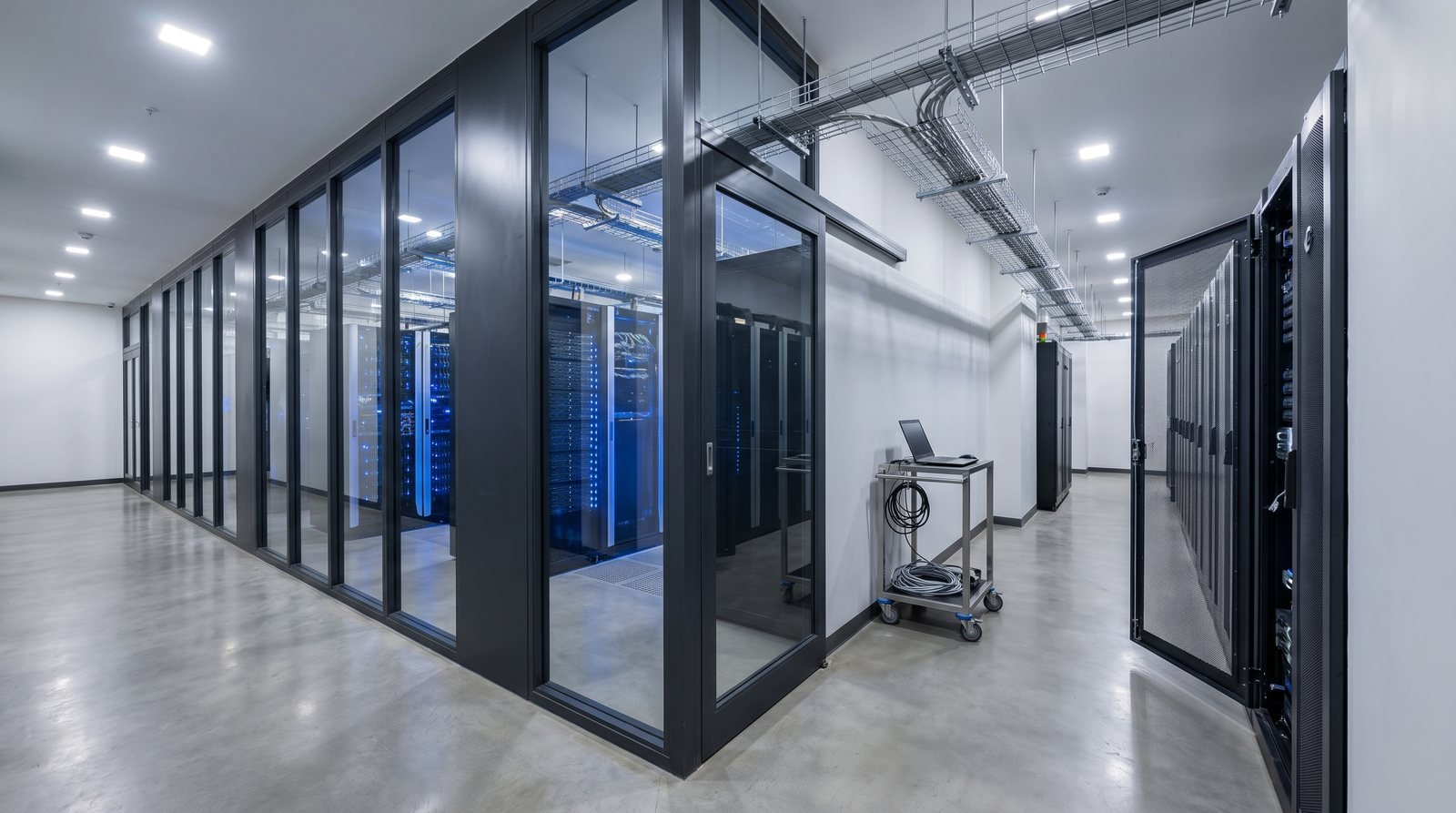
Compartmentation around white space and plant rooms, with vision panels that survive the rating.
Next step
Request the catalogue
Profile geometry, component schedules and typologies for all three systems, and the test report behind BR-Shield. Tell us what you are specifying.
Or talk to a person